Vielmetter Los Angeles is excited to announce Paul Mpagi Sepuya’s solo exhibition, Compressed Tenses, curated by Michael Goodson which will be on view as part of the FotoFocus Biennial in Cincinnatti, Ohio. The exhibition will be on view from October 2nd through December 20th, 2026 at the Alice F. and Harris K. Weston Art Gallery.
Photographing friends, artists, collaborators, and himself, Paul Mpagi Sepuya challenges traditional portraiture through layering, fragmentation, mirror imagery, and the perspective of the Black, queer gaze.
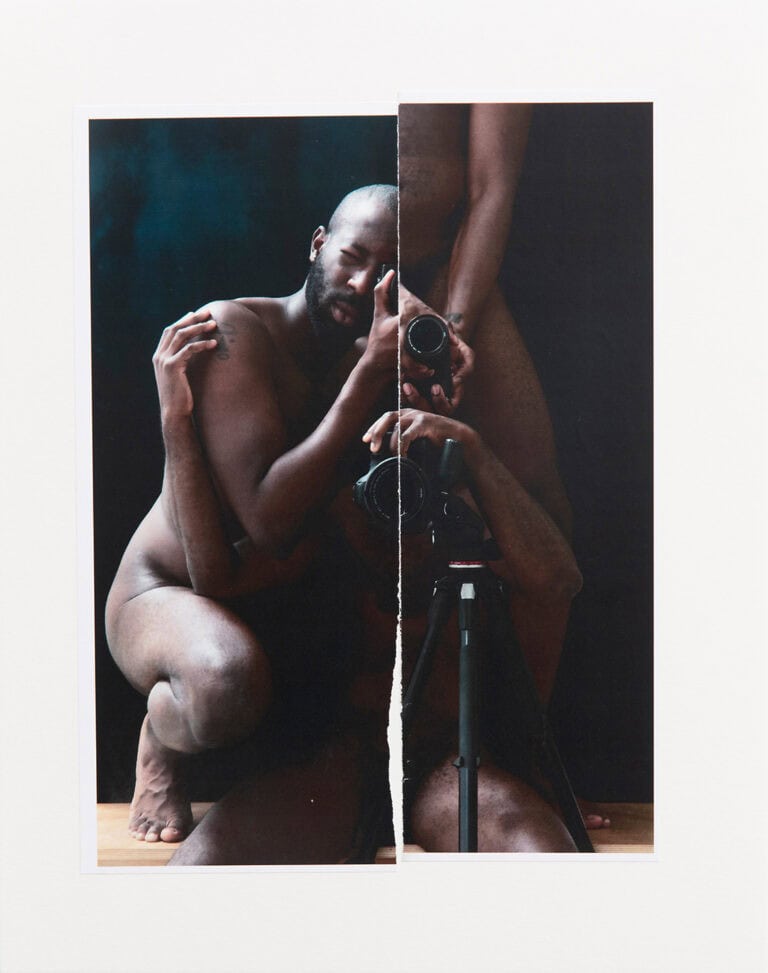
Sepuya’s practice is grounded in the studio as a site where people, objects, and experiences are both positioned and displaced. Early works made in his Brooklyn apartment simultaneously depict presence and absence, while works made following his move to Los Angeles become increasingly complex in their composition. Utilizing mirrors to radically alter the dynamics of a portrait or a scene, he allows glimpses of the studio setting and reveals the apparatus of photography, including backdrops, lighting, lenses, and the camera itself. Although little is hidden, much is obscured and fragmented, with narratives left open to conjecture. In contrast to the slick artifice of traditional or commercial portraiture, Sepuya points to the human element of picture taking—embracing fingerprints, smudges, and the dust on a mirror’s surface to make his images, and photography, more tactile.
Compressed Tenses explores an ancillary and ongoing practice of physical collage in Sepuya’s oeuvre. Starting with a Rauschenberg Residency in 2018, Sepuya deploys constructs previously employed in his studio practice, exploring the history of the homoerotic photograph, complicated by current conversations around queerness and Blackness. His collages are in direct conversation with his studio work. Using a small laser printer, the images are torn and their fragments directly re-arranged on sheets of paper. Together, they create analog compositions reminiscent of his larger digital works and encapsulate the multi-layered investigation of various histories: the gaze, otherness, queerness and the Black body, and, of course, the history of photography itself.