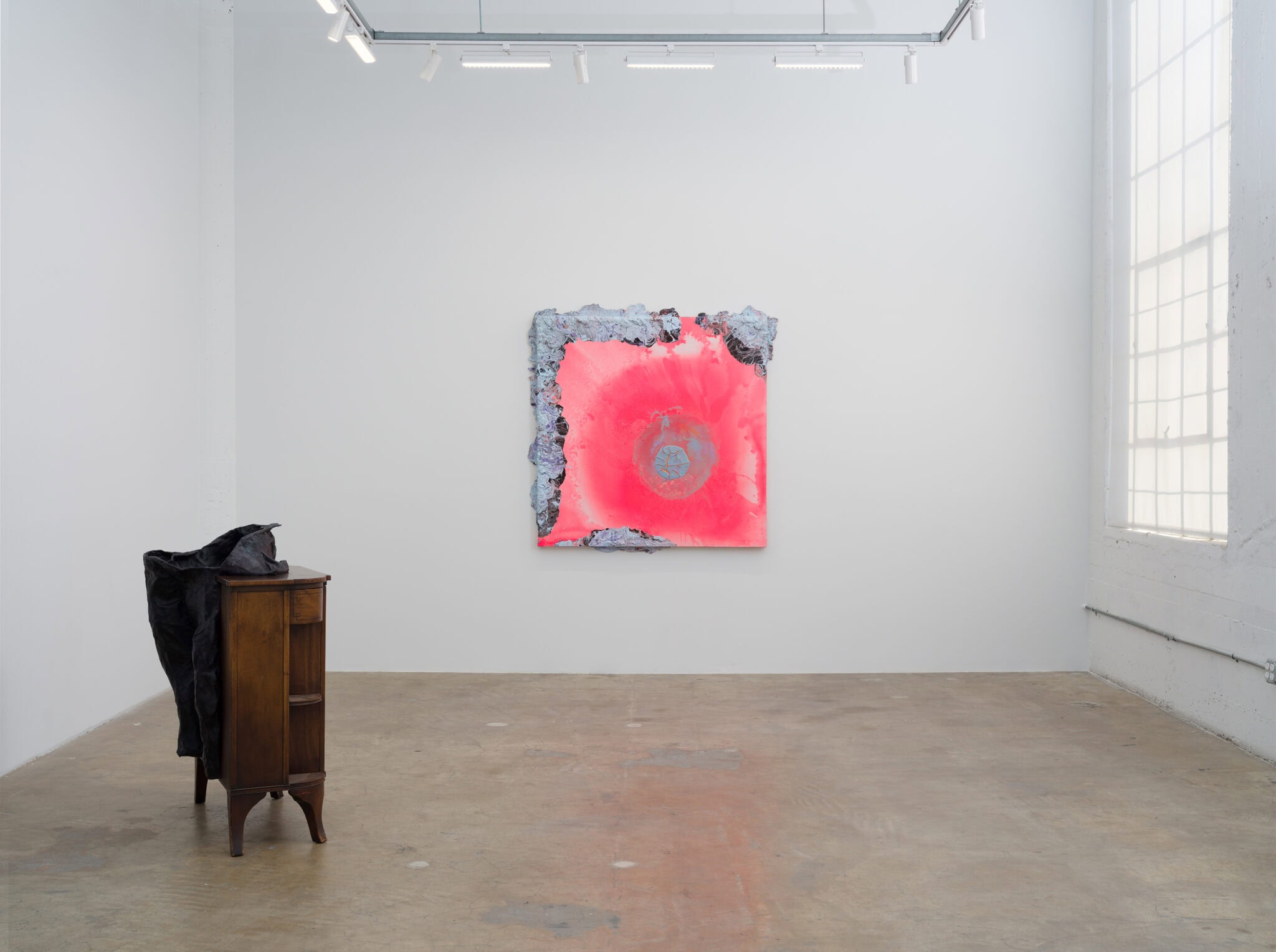
Installation photo credit: Jeff McLane
Opening reception: January 10, 2026 4 – 6pm
Vielmetter Los Angeles is pleased to present Rodney McMillian’s solo exhibition Some lives in the sunshine, opening January 10 and on view through February 28, 2026.
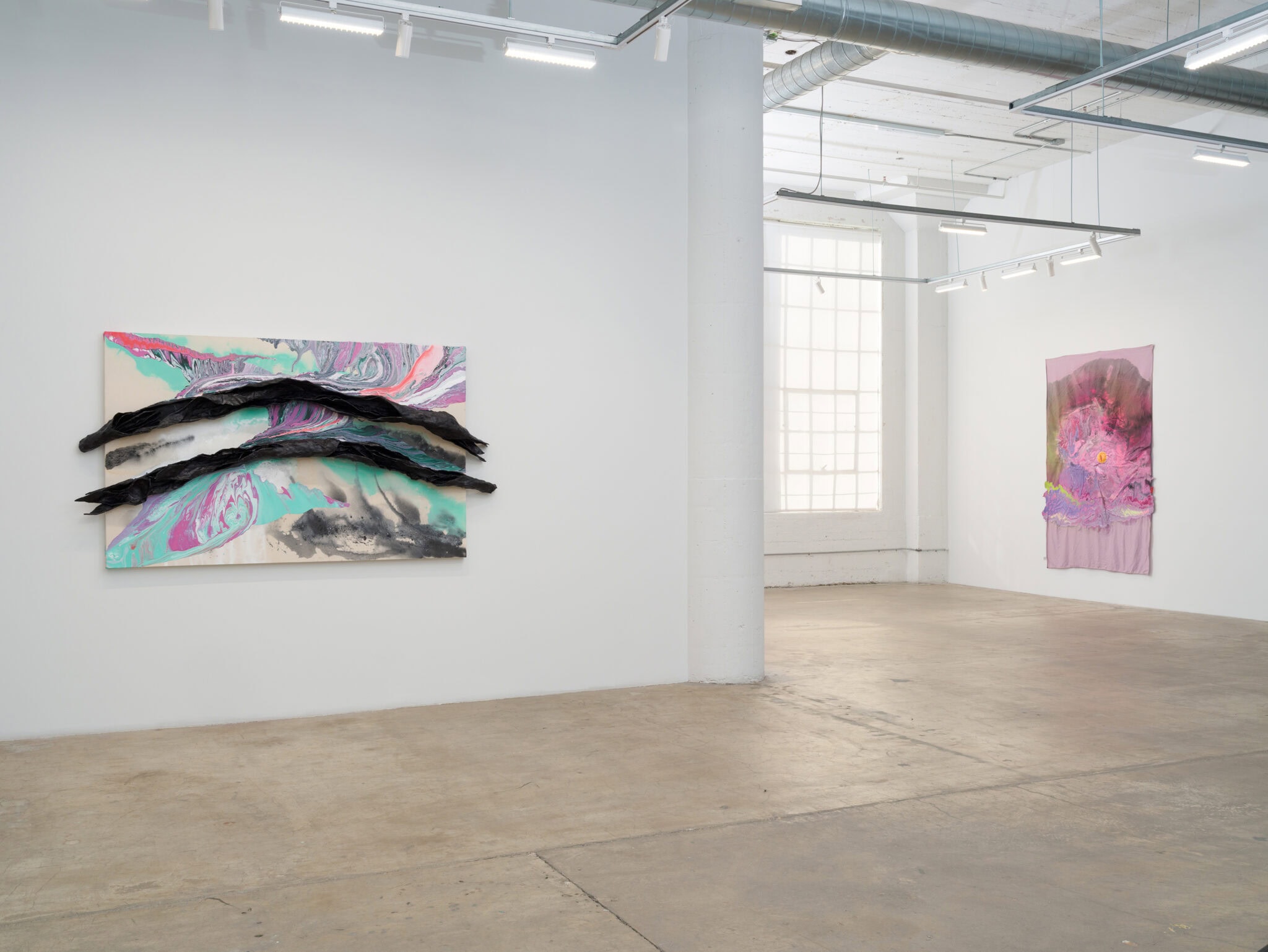
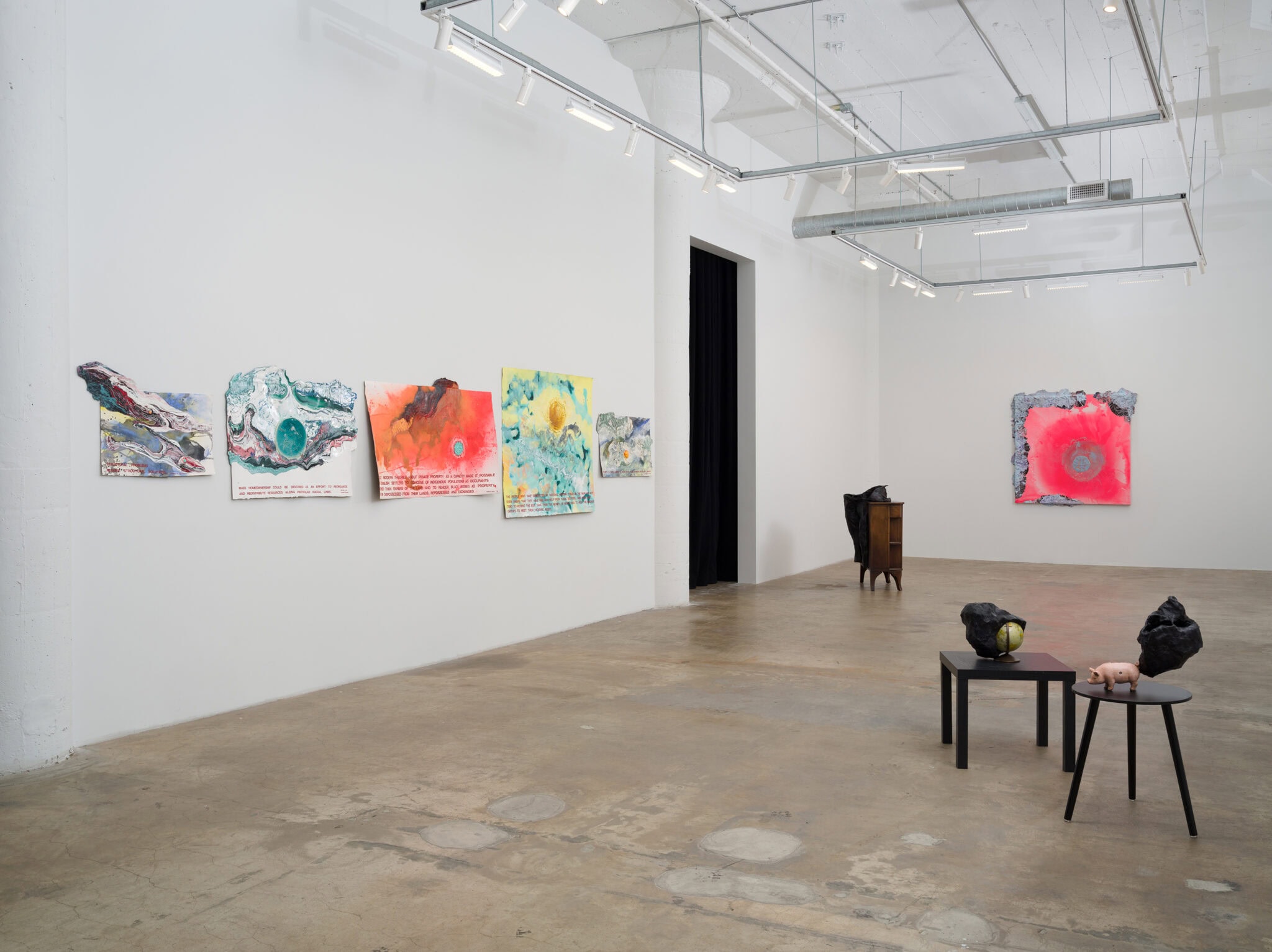
McMillian’s practice spans painting, video, sculpture, and installation and is grounded in research into the intersections of race, class, and power as they shape both the history and present of American lives and land. His new body of work comprises sculptures, works on paper, and paintings that examine the history of redlining and predatory lending in the United States—discriminatory practices that persist long after being ruled illegal and continue to structure the nation’s unequal, racially inflected distribution of wealth.
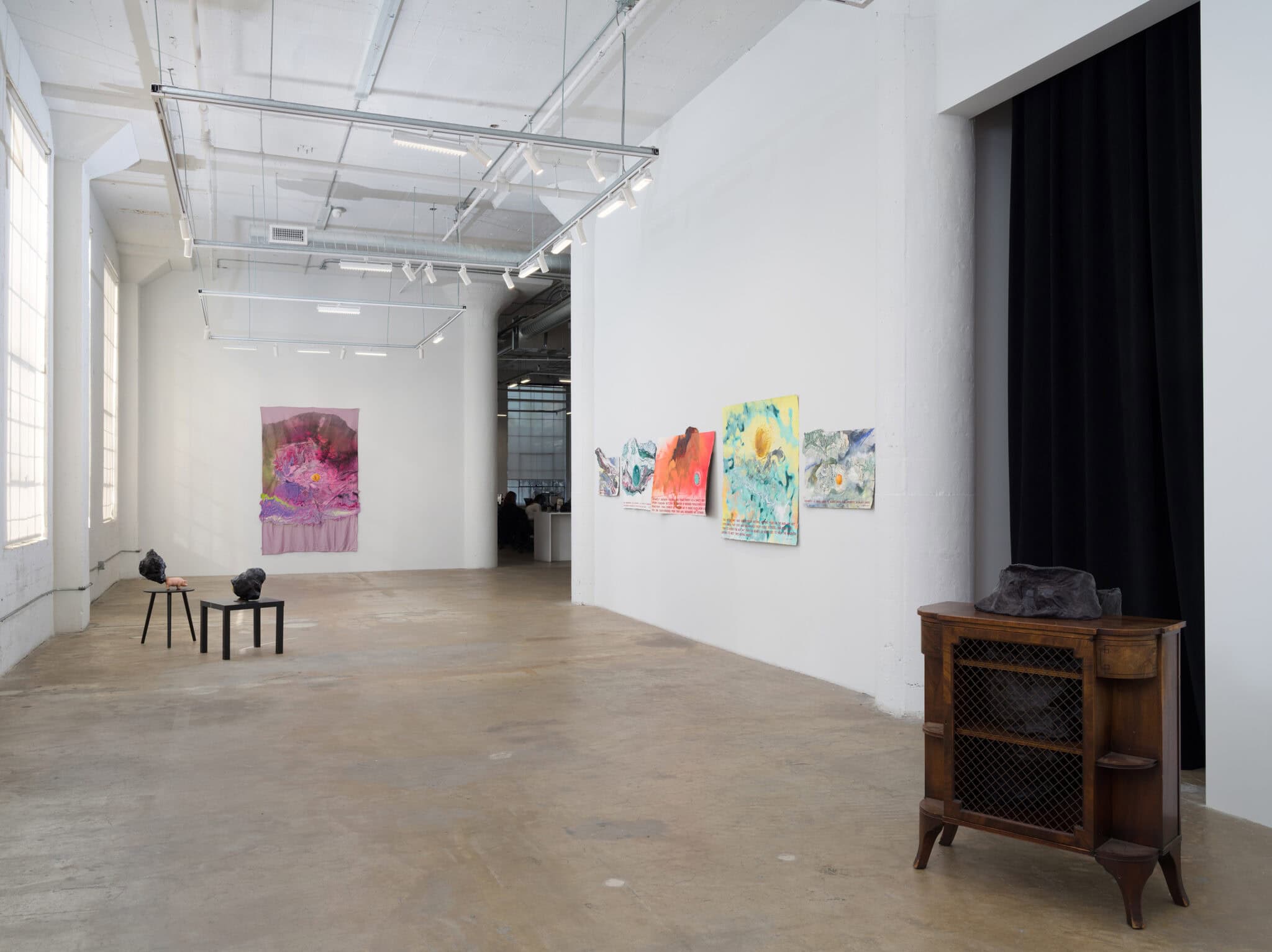
Working with nontraditional, utilitarian materials such as house paint, chicken wire, blankets, and bed sheets, McMillian’s paintings and sculptures allude to domestic spaces while engaging modernist traditions of the ready-made and found object. He has incorporated thrifted materials or post-consumer objects into his practice for decades, often leaving price tags and stains intact; these traces of prior use and value provide fertile ground for new narratives. In this exhibition, materials include piggy banks and furniture modified with black protuberances formed from duck cloth and chicken wire, as well as blankets and citations. The paintings and drawings in Some lives in the sunshine reference the boisterous pink and violet palette of magic hour—colors shaped equally by pollution and refraction—alongside the unequal access to economic sustainability experienced beneath the solar glow.
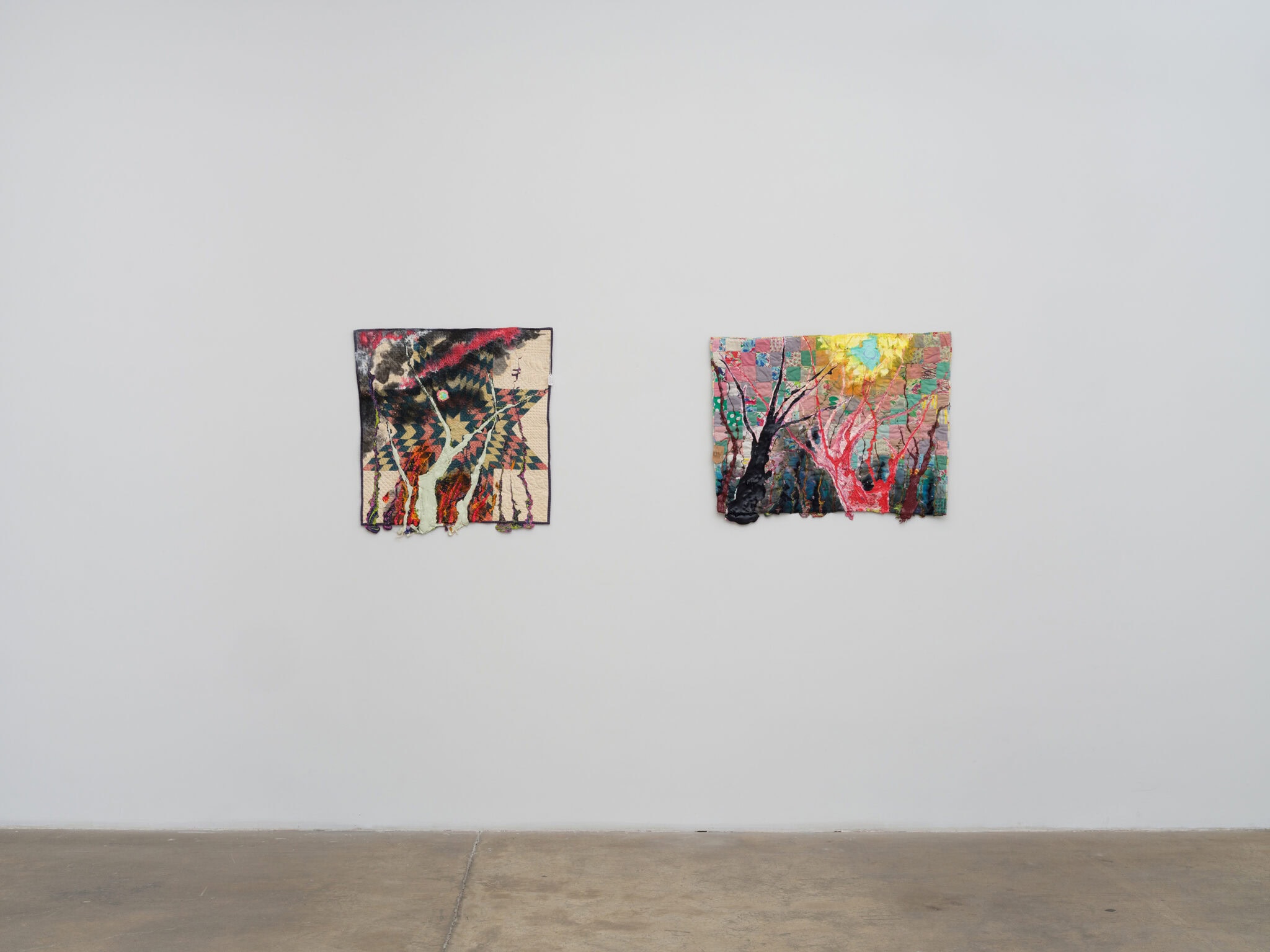
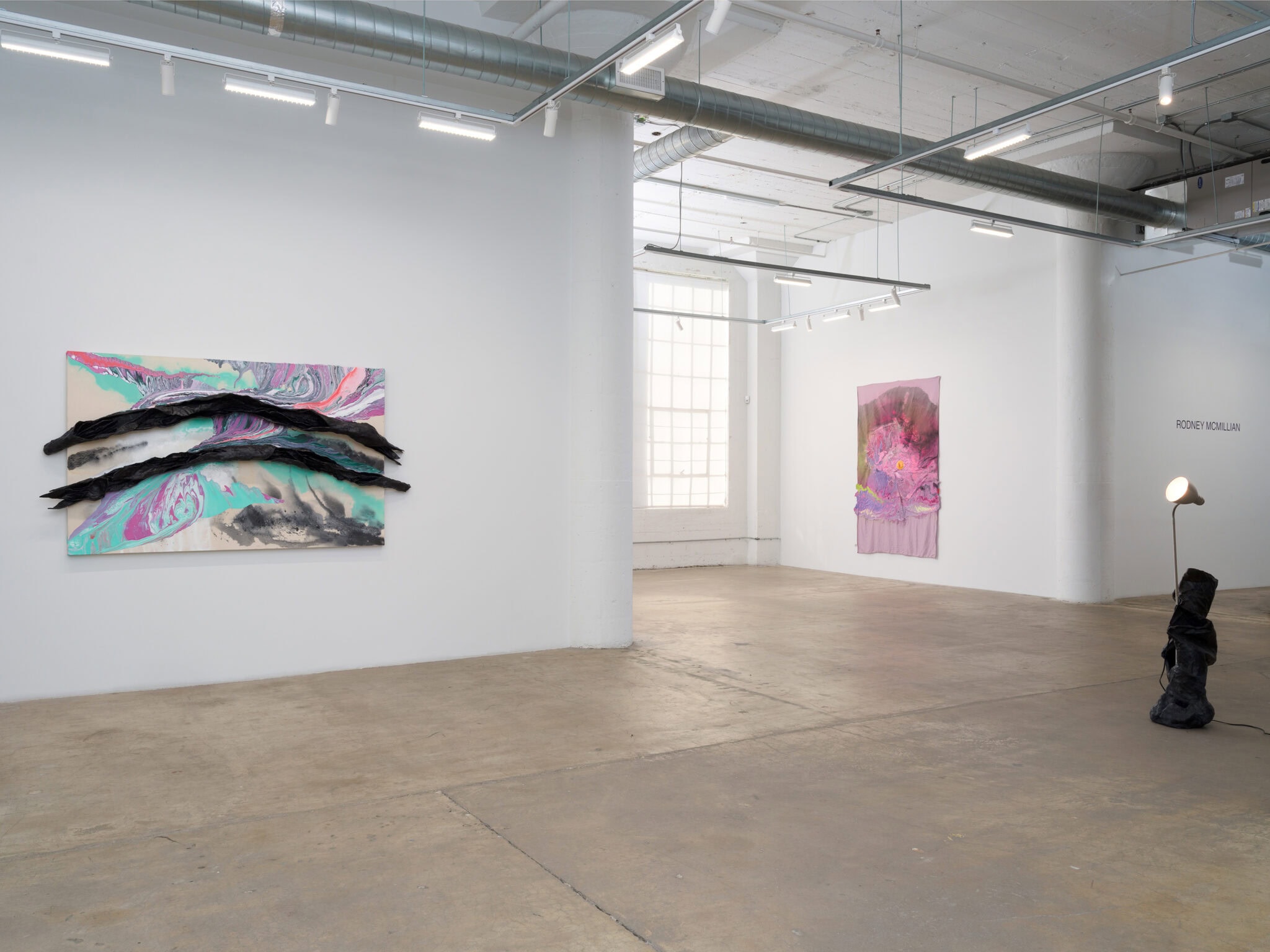
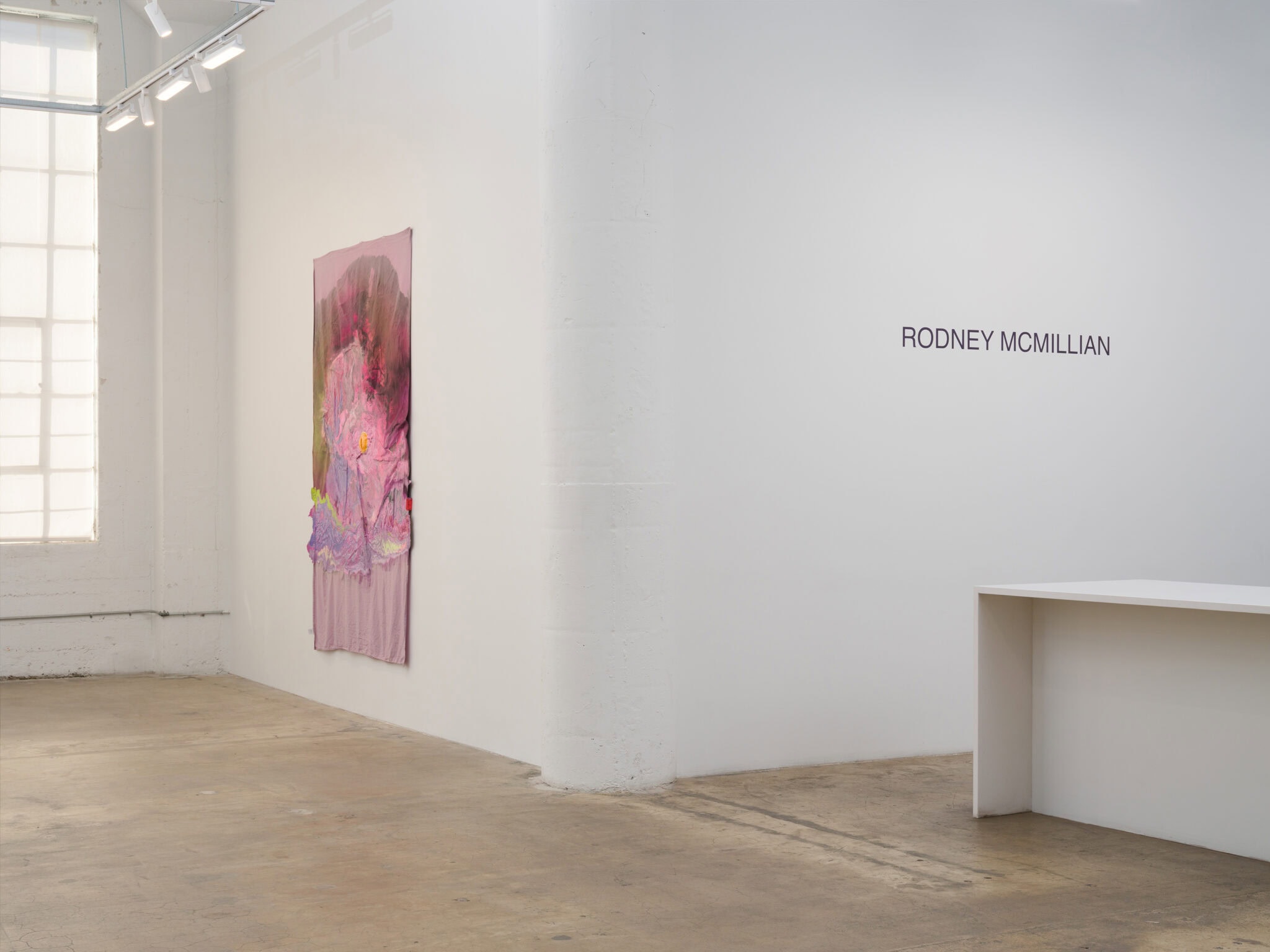
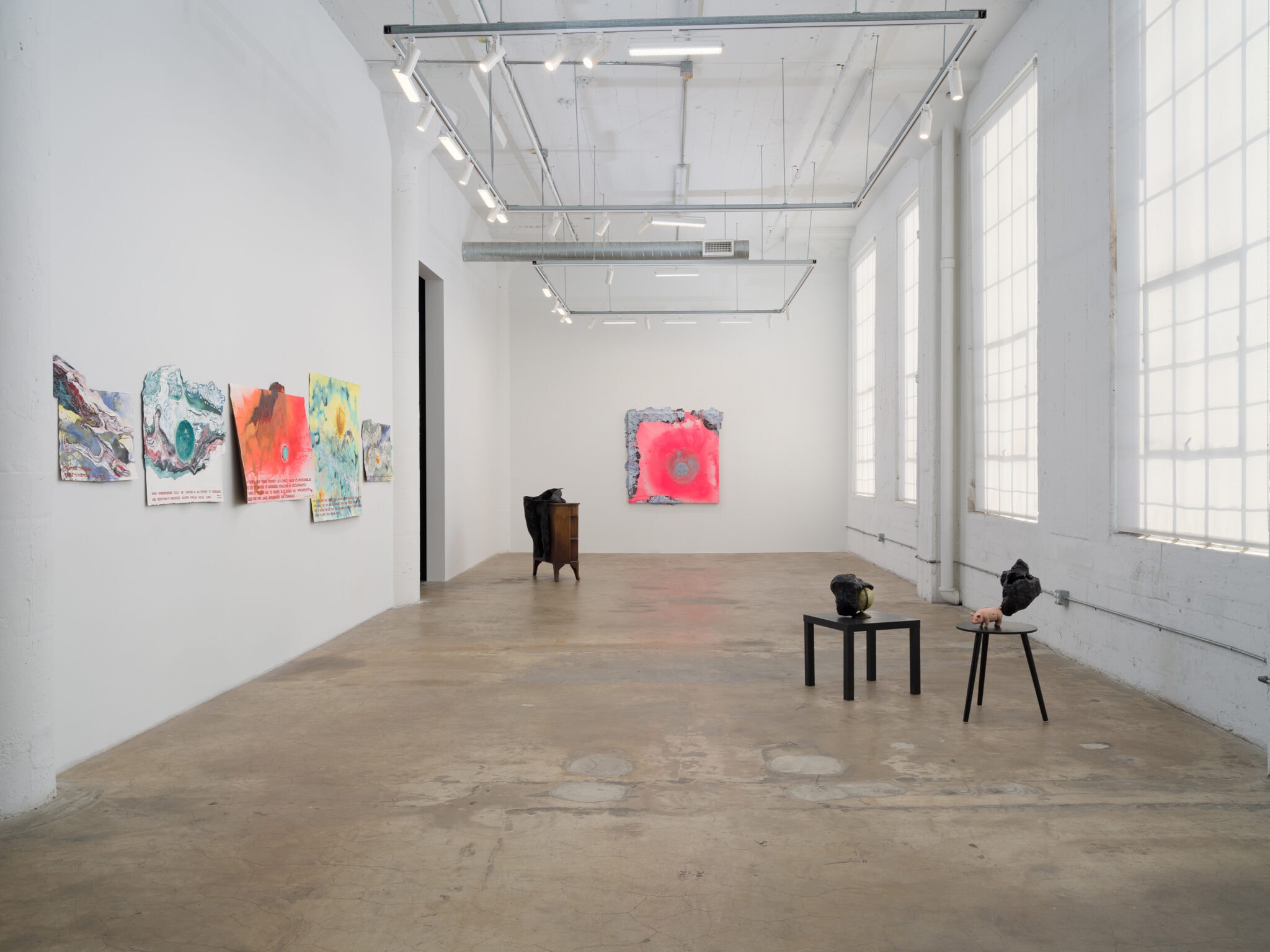
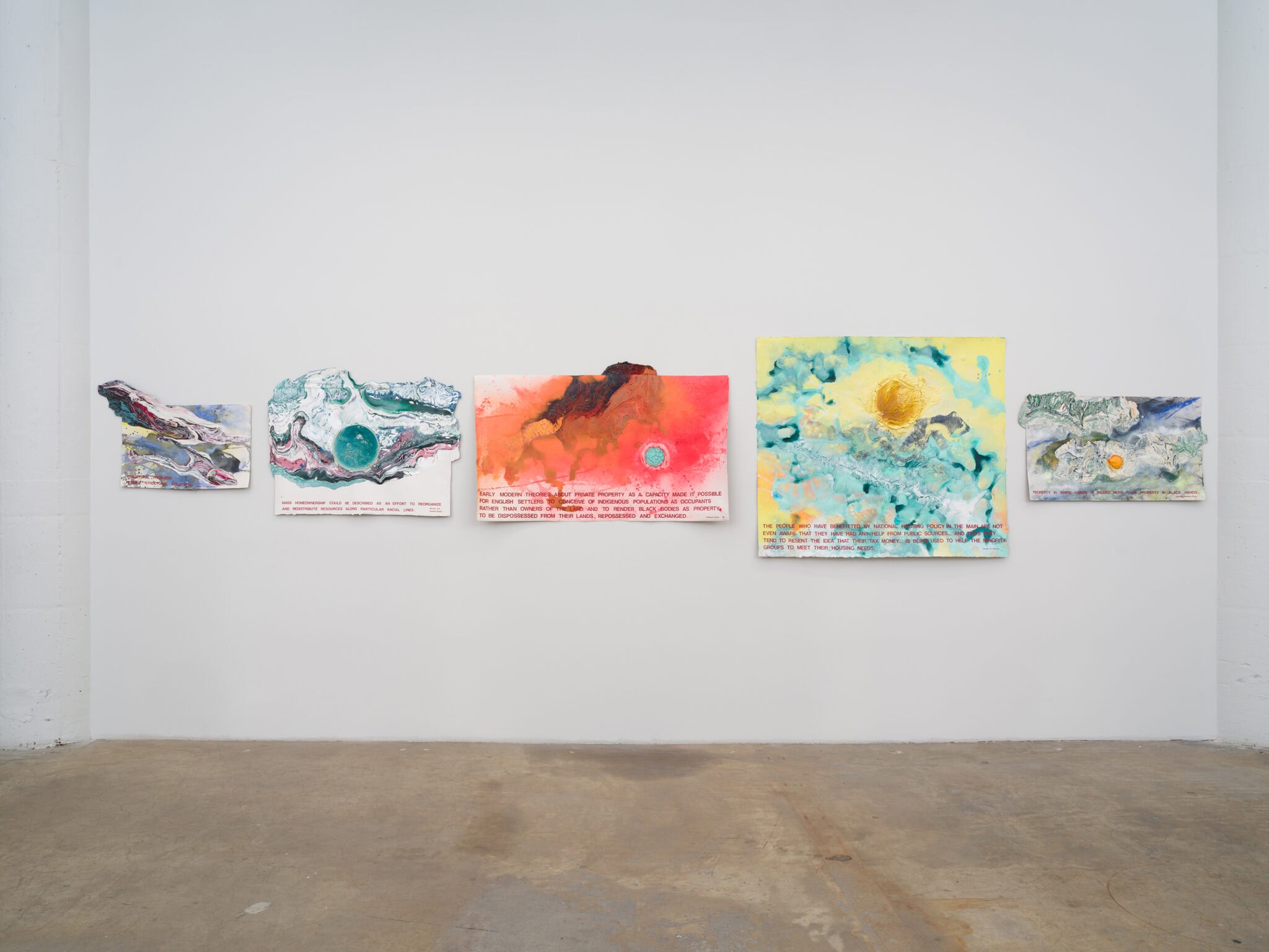
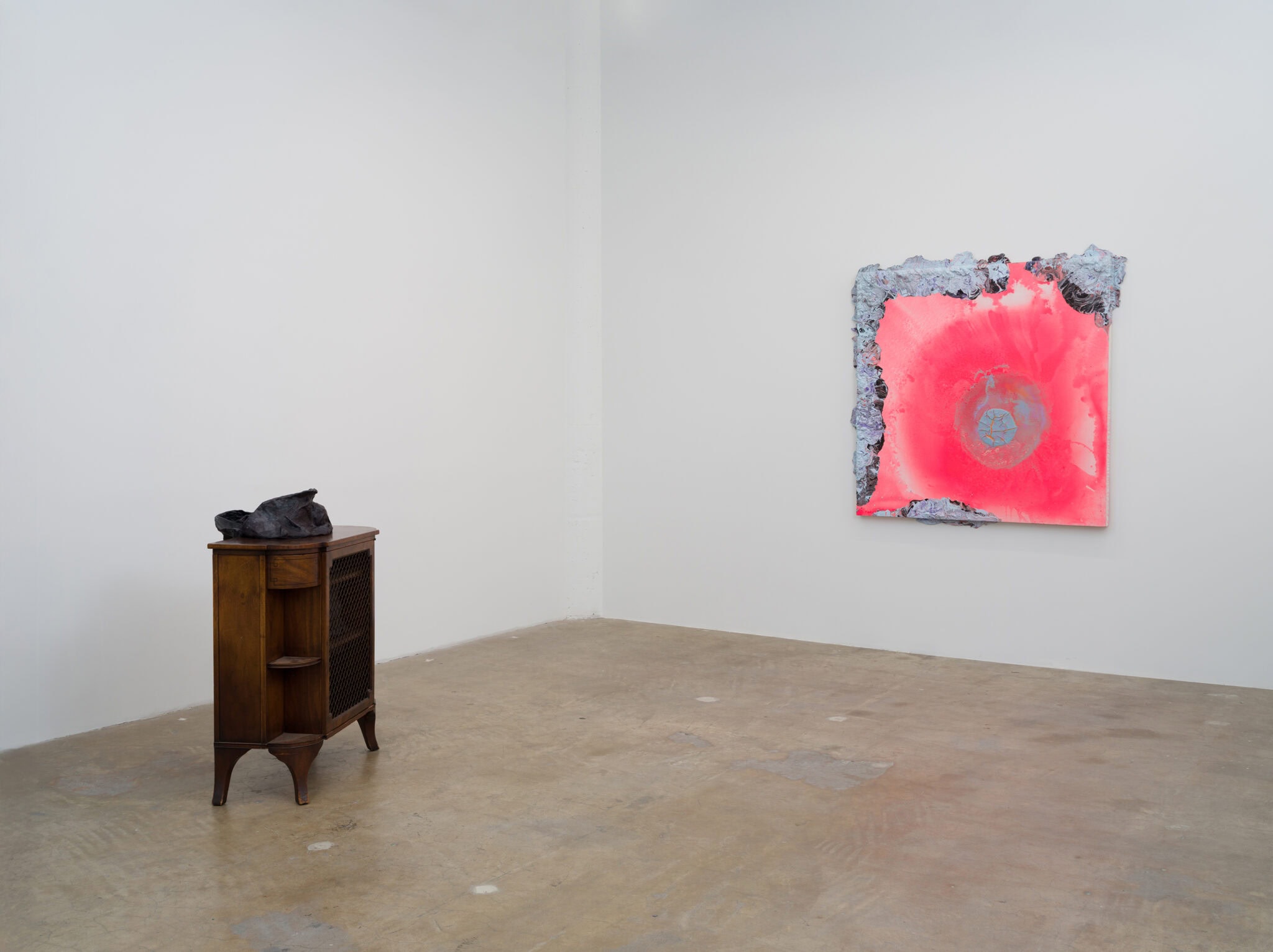
In a series of works on paper that builds on his 2020 exhibition Body Politic, McMillian pairs quotes from articles and publications addressing the history and ongoing effects of discriminatory housing policies, from the 1940s to the present, with poured paint sunsets. These works draw on texts such as Richard Rothstein’s The Color of Law: A Forgotten History of How Our Government Segregated America and Keeanga-Yamahtta Taylor’s Race for Profit: How Banks and the Real Estate Industry Undermined Black Homeownership. The formal relationship between text and landscape mirrors how these policies have seeped into the nation’s lived infrastructure, continuing to produce tangible consequences on both personal and political levels. Shown alongside a new poured landscape on a thrifted quilt and a stretched canvas featuring a poured landscape and black excrescence, the drawings extend the artist’s long-standing examination of the violence embedded in the abstraction of histories and legacies of slavery and systemic racism.
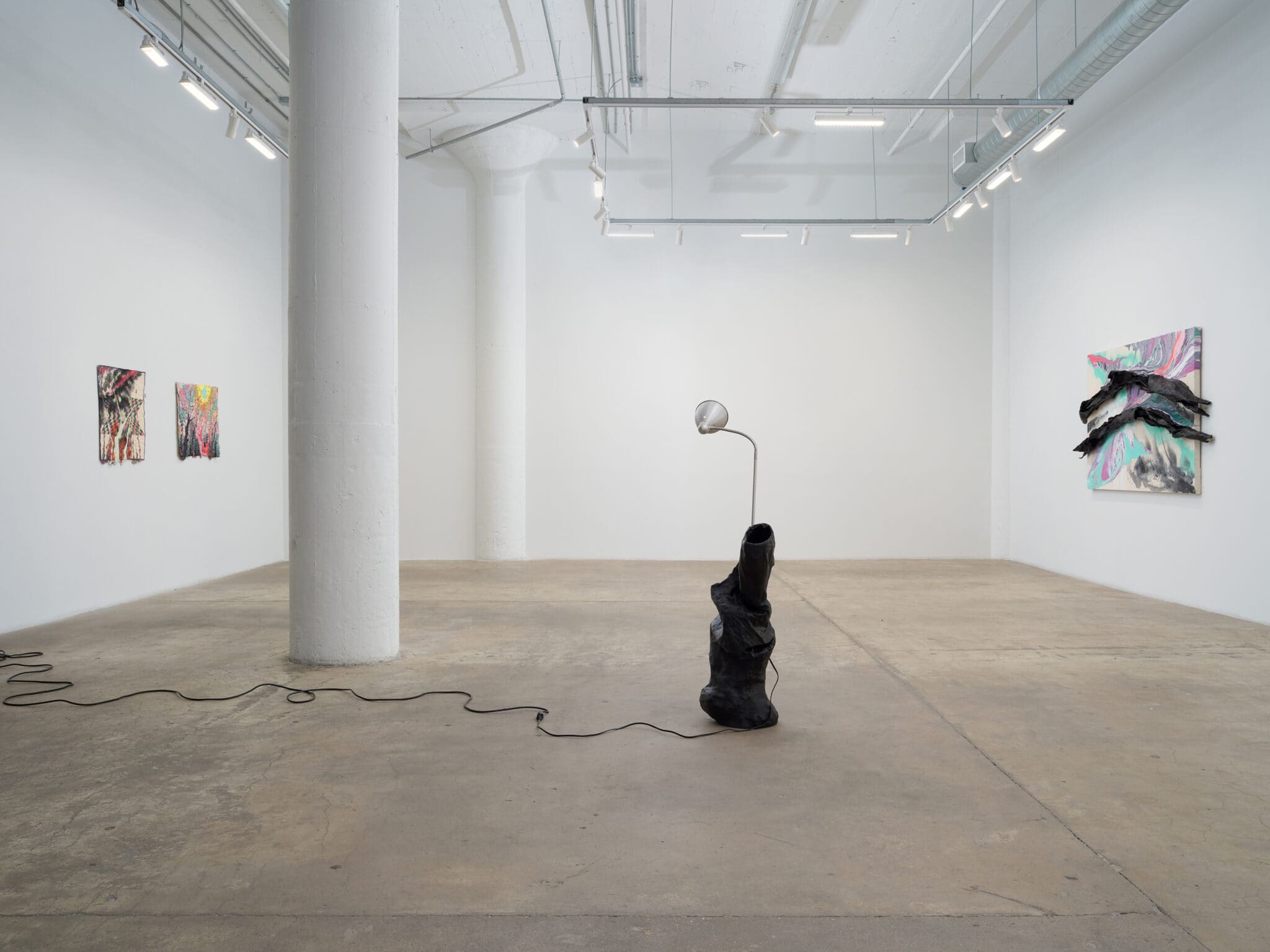
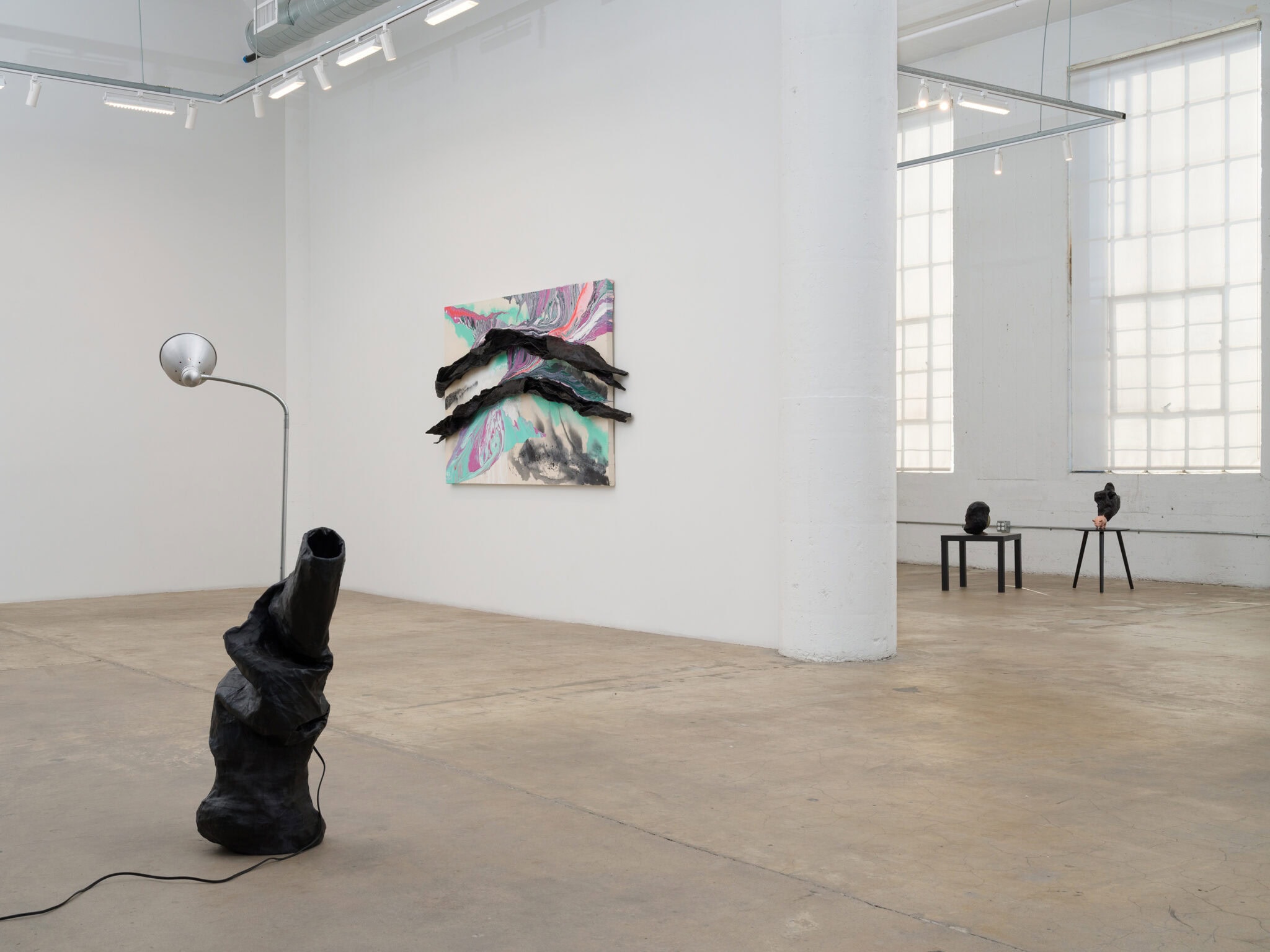
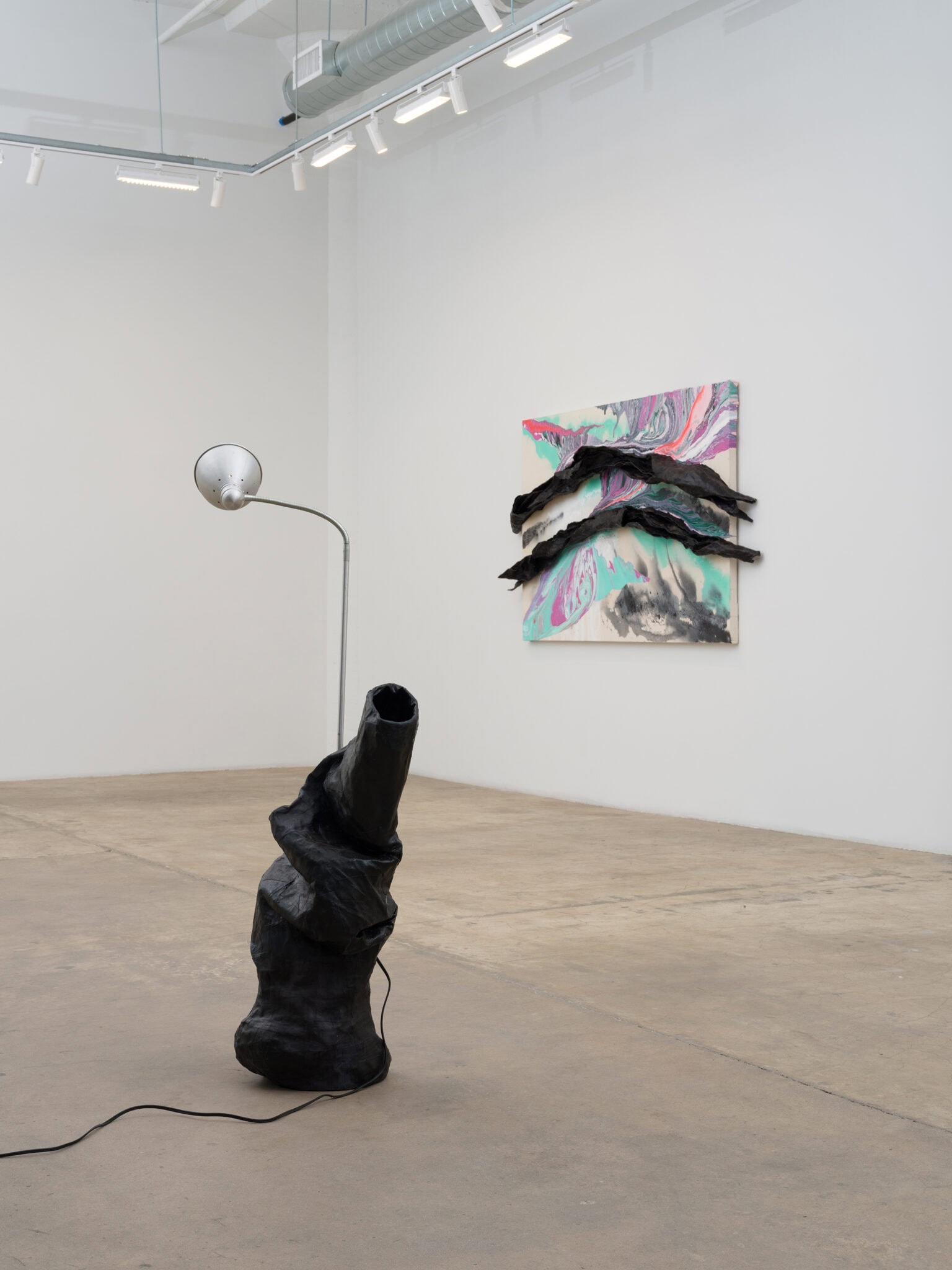
Throughout the gallery, repurposed piggy banks and furniture are installed as sculptural works, their forms altered with additions of chicken wire, duck cloth, and black paint. These ghostly appendages evoke body parts, tumors, and severed casts. While the post-consumer objects themselves conjure the myth of the American Dream and its economic aspirations, the ominous, undulating forms introduce an atmosphere of foreboding and unease. In other works, a metal lamp and an oak cabinet are alternately permeated and engulfed by shadowy shapes, suggesting black holes, orifices, malignant growths, or portals. For McMillian, these interventions reference speculative fiction by writers such as Octavia E. Butler and Ursula Le Guin, in which time, space, and social constructs of race, class, and gender are imagined as porous and nonlinear.
McMillian’s landscape paintings further articulate the environmental aftermath of these historical policies. One painting features a black double rainbow constructed from the same chicken wire and duck cloth used in the sculptures, its arcs anchored by a dramatic sky swirling with teal, pink, and black house paint. The rainbow appears as a thick, monochromatic, intestinal form, ruptured and cleft in places. Another landscape depicts a line of sinuous, tree-like forms beneath an ominous yellow-and-blue sun, drawing out the hues of the handmade quilt that serves as its ground. By incorporating cast-off bedding and bed sheets into these works, McMillian summons an absent body into the environments he creates, its ghostly presence palpable in the carefully stitched seams and signs of wear embedded in the fabric.
About the artist
Rodney McMillian was born in 1969 in Columbia, South Carolina, and lives and works in Los Angeles, CA. He received an MFA from the California Institute of the Arts in 2002.
McMillian will have a solo exhibition at the Columbia Museum of Art in South Carolina in the Spring of 2026 curated by Michael Neumeister. In 2025, McMillian’s work was the subject of a solo exhibition, neighbors, at the Henry Art Gallery in Seattle. In 2024, McMillian had a survey exhibition The Land: Not Without a Politic, at the Marta Herford, in Herford, Germany. McMillian was included in the 2022 Whitney Biennial, Quiet as It’s Kept, curated by David Breslin and Adrienne Edwards; the 2021 Prospect.5 New Orleans: Yesterday You Said Tomorrow, curated by Naima Keith and Diana Nawi; and he was included in the 2008 Whitney Biennale, which was curated by Henriette Huldisch and Shamim Momin. Other notable solo exhibitions include the 2020 solo exhibition, Historically Hostile, at the Blaffer Museum in Houston, Texas, and the 2019 solo exhibitions at the Underground Museum in Los Angeles, Brown: videos at the Black Show, and the San Francisco Museum of Modern Art, New Work: Rodney McMillian.
McMillian received the Contemporary Austin’s first Suzanne Deal Booth Art Prize in 2016, and the resulting solo exhibition Against a Civic Death at the Austin Contemporary was on view in 2018. In 2016, his works were featured solo exhibitions at the ICA Philadelphia, the Studio Museum in Harlem, and MoMA PS.1. Each of these exhibitions highlighted a particular set of material and conceptual concerns in McMillian’s multivalent practice. The MoMA PS.1 exhibition, Landscape Paintings originated at the Aspen Art Museum, Colorado in 2015 and was curated by Heidi Zuckerman. McMillian’s work was also featured in the 2015 Sharjah Biennial, curated by Eungie Joo.
Group exhibitions include The National Portrait Gallery, London, MASS MoCA, North Adams, MA; the CCA Wattis Institute, San Francisco, CA; the Astrup Fearnley Museet, Oslo, Norway; The Institute of Contemporary Art, Boston; The Institute of Contemporary Art, Philadelphia; the Contemporary Art Museum Houston; the Museum of Contemporary Art, Los Angeles; the Museum of Contemporary Art, Chicago; the UCLA Hammer Museum, Los Angeles; and the Los Angeles County Museum of Art among many others. McMillian’s work is included in the collections of the Hammer Museum, Los Angeles; Museum of Contemporary Art, Los Angeles; Museum of Modern Art, New York; San Francisco Museum of Modern Art, San Francisco; Staedtisches Museum Abteiberg, Moenchengladbach, Germany; and The Studio Museum in Harlem, New York. Rodney McMillian is represented by Vielmetter Los Angeles and Petzel, New York.
“Texas Star quilt (poured & stained),” 2025
Latex, acrylic and ink on quilt
28" x 31 ¹⁄₂" [HxW] (71.12 x 80.01 cm)
Inventory #MCR474
Courtesy of the artist and Vielmetter Los Angeles
Photo credit: Brica Wilcox
![This image depicts an artwork by Rodney McMillian titled "Texas Star quilt (poured & stained)." This artwork was created in 2025 and measures 28" x 31 ¹⁄₂" [HxW] (71.12 x 80.01 cm). Its medium is Latex, acrylic and ink on quilt.](https://vielmetter.com/wp-content/uploads/2026/01/Rodney-McMillian_MCR474_1768070136-scaled.jpg)
“Texas Star quilt (poured & stained),” 2025
Latex, acrylic and ink on quilt
28" x 31 ¹⁄₂" [HxW] (71.12 x 80.01 cm)
Inventory #MCR474
Courtesy of the artist and Vielmetter Los Angeles
Photo credit: Brica Wilcox
“1950's Lap quilt (drenched),” 2025
Latex, acrylic, and ink on quilt
28" x 35" [HxW] (71.12 x 88.9 cm)
Inventory #MCR490
Courtesy of the artist and Vielmetter Los Angeles
Photo credit: Jeff McLane
![This image depicts an artwork by Rodney McMillian titled "1950's Lap quilt (drenched)." This artwork was created in 2025 and measures 28" x 35" [HxW] (71.12 x 88.9 cm). Its medium is Latex, acrylic, and ink on quilt.](https://vielmetter.com/wp-content/uploads/2026/01/Rodney-McMillian_MCR490_1768070090-scaled.jpg)
“1950's Lap quilt (drenched),” 2025
Latex, acrylic, and ink on quilt
28" x 35" [HxW] (71.12 x 88.9 cm)
Inventory #MCR490
Courtesy of the artist and Vielmetter Los Angeles
Photo credit: Jeff McLane
“Lamp (sunshine),” 2024-2025
Lamp, chicken wire, fabric, and acrylic
61" x 14" x 20" [HxWxD] (154.94 x 35.56 x 50.8 cm)
Inventory #MCR501
Courtesy of the artist and Vielmetter Los Angeles
Photo credit: Jeff McLane
![This image depicts an artwork by Rodney McMillian titled "Lamp (sunshine)." This artwork was created in 2024-2025 and measures 61" x 14" x 20" [HxWxD] (154.94 x 35.56 x 50.8 cm). Its medium is Lamp, chicken wire, fabric, and acrylic.](https://vielmetter.com/wp-content/uploads/2026/01/Rodney-McMillian_MCR501_1768070118-scaled.jpg)
“Lamp (sunshine),” 2024-2025
Lamp, chicken wire, fabric, and acrylic
61" x 14" x 20" [HxWxD] (154.94 x 35.56 x 50.8 cm)
Inventory #MCR501
Courtesy of the artist and Vielmetter Los Angeles
Photo credit: Jeff McLane
“double rainbow,” 2025
Latex, acrylic, graphite, fabric, chicken wire on canvas
48" x 90" x 9" [HxWxD] (121.92 x 228.6 x 22.86 cm)
Inventory #MCR489
Courtesy of the artist and Vielmetter Los Angeles
Photo credit: Jeff McLane
![This image depicts an artwork by Rodney McMillian titled "double rainbow." This artwork was created in 2025 and measures 48" x 90" x 9" [HxWxD] (121.92 x 228.6 x 22.86 cm). Its medium is Latex, acrylic, graphite, fabric, chicken wire on canvas.](https://vielmetter.com/wp-content/uploads/2026/01/Rodney-McMillian_MCR489_1768070045-scaled.jpg)
“double rainbow,” 2025
Latex, acrylic, graphite, fabric, chicken wire on canvas
48" x 90" x 9" [HxWxD] (121.92 x 228.6 x 22.86 cm)
Inventory #MCR489
Courtesy of the artist and Vielmetter Los Angeles
Photo credit: Jeff McLane
“Piggy Bank (where the sun doesn't shine),” 2024-2025
Piggy bank, chicken wire, fabric, and acrylic
14" x 17" x 8" [HxWxD] (35.56 x 43.18 x 20.32 cm)
Inventory #MCR491
Courtesy of the artist and Vielmetter Los Angeles
Photo credit: Jeff McLane
![This image depicts an artwork by Rodney McMillian titled "Piggy Bank (where the sun doesn't shine)." This artwork was created in 2024-2025 and measures 14" x 17" x 8" [HxWxD] (35.56 x 43.18 x 20.32 cm). Its medium is Piggy bank, chicken wire, fabric, and acrylic.](https://vielmetter.com/wp-content/uploads/2026/01/Rodney-McMillian_MCR491_1768070199-scaled.jpg)
“Piggy Bank (where the sun doesn't shine),” 2024-2025
Piggy bank, chicken wire, fabric, and acrylic
14" x 17" x 8" [HxWxD] (35.56 x 43.18 x 20.32 cm)
Inventory #MCR491
Courtesy of the artist and Vielmetter Los Angeles
Photo credit: Jeff McLane
“Piggy Bank (globe),” 2024-2025
Globe, fabric, chicken wire, and acrylic
Scupture: 11" x 12" x 9" [HxWxD] (27.94 x 30.48 x 22.86 cm)
Overall: 30 ¹⁄₂" x 19" [HxW] (77.47 x 48.26 cm)
Inventory #MCR493
Courtesy of the artist and Vielmetter Los Angeles
Photo credit: Jeff McLane
![This image depicts an artwork by Rodney McMillian titled "Piggy Bank (globe)." This artwork was created in 2024-2025 and measures Scupture: 11" x 12" x 9" [HxWxD] (27.94 x 30.48 x 22.86 cm)Overall: 30 ¹⁄₂" x 19" [HxW] (77.47 x 48.26 cm). Its medium is Globe, fabric, chicken wire, and acrylic.](https://vielmetter.com/wp-content/uploads/2026/01/Rodney-McMillian_MCR493_1768070239-scaled.jpg)
“Piggy Bank (globe),” 2024-2025
Globe, fabric, chicken wire, and acrylic
Scupture: 11" x 12" x 9" [HxWxD] (27.94 x 30.48 x 22.86 cm)
Overall: 30 ¹⁄₂" x 19" [HxW] (77.47 x 48.26 cm)
Inventory #MCR493
Courtesy of the artist and Vielmetter Los Angeles
Photo credit: Jeff McLane
“Untitled (where the sun shines),” 2024 -2025
Acrylic, latex, and ink on bed sheet
95" x 63 ¹⁄₂" [HxW] (241.3 x 161.29 cm)
Inventory #MCR499
Courtesy of the artist and Vielmetter Los Angeles
Photo credit: Jeff McLane
![This image depicts an artwork by Rodney McMillian titled "Untitled (where the sun shines)." This artwork was created in 2024 -2025 and measures 95" x 63 ¹⁄₂" [HxW] (241.3 x 161.29 cm). Its medium is Acrylic, latex, and ink on bed sheet.](https://vielmetter.com/wp-content/uploads/2026/01/Rodney-McMillian_MCR499_1768080460.jpg)
“Untitled (where the sun shines),” 2024 -2025
Acrylic, latex, and ink on bed sheet
95" x 63 ¹⁄₂" [HxW] (241.3 x 161.29 cm)
Inventory #MCR499
Courtesy of the artist and Vielmetter Los Angeles
Photo credit: Jeff McLane
“Problems and Solutions,” 2020-2025
Acrylic, latex, ink, pastel and vinyl on paper
21 ¹⁄₂" x 31" [HxW] (54.61 x 78.74 cm)
Inventory #MCR496
Courtesy of the artist and Vielmetter Los Angeles
Photo credit: Jeff McLane
![This image depicts an artwork by Rodney McMillian titled "Problems and Solutions." This artwork was created in 2020-2025 and measures 21 ¹⁄₂" x 31" [HxW] (54.61 x 78.74 cm). Its medium is Acrylic, latex, ink, pastel and vinyl on paper.](https://vielmetter.com/wp-content/uploads/2026/01/Rodney-McMillian_MCR496_1768080476.jpg)
“Problems and Solutions,” 2020-2025
Acrylic, latex, ink, pastel and vinyl on paper
21 ¹⁄₂" x 31" [HxW] (54.61 x 78.74 cm)
Inventory #MCR496
Courtesy of the artist and Vielmetter Los Angeles
Photo credit: Jeff McLane
“Mass Homeownership,” 2025
Latex and vinyl on paper
38" x 29 ¹⁄₂" [HxW] (96.52 x 74.93 cm)
Inventory #MCR495
Courtesy of the artist and Vielmetter Los Angeles
Photo credit: Jeff McLane
![This image depicts an artwork by Rodney McMillian titled "Mass Homeownership." This artwork was created in 2025 and measures 38" x 29 ¹⁄₂" [HxW] (96.52 x 74.93 cm). Its medium is Latex and vinyl on paper.](https://vielmetter.com/wp-content/uploads/2026/01/Rodney-McMillian_MCR495_1768070018-scaled.jpg)
“Mass Homeownership,” 2025
Latex and vinyl on paper
38" x 29 ¹⁄₂" [HxW] (96.52 x 74.93 cm)
Inventory #MCR495
Courtesy of the artist and Vielmetter Los Angeles
Photo credit: Jeff McLane
“Some Theories about Private Property,” 2025
Acrylic, latex and vinyl on paper
32 ¹⁄₂" x 51 ¹⁄₂" [HxW] (82.55 x 130.81 cm)
Inventory #MCR503
Courtesy of the artist and Vielmetter Los Angeles
Photo credit: Jeff McLane
![This image depicts an artwork by Rodney McMillian titled "Some Theories about Private Property." This artwork was created in 2025 and measures 32 ¹⁄₂" x 51 ¹⁄₂" [HxW] (82.55 x 130.81 cm). Its medium is Acrylic, latex and vinyl on paper.](https://vielmetter.com/wp-content/uploads/2026/01/Rodney-McMillian_MCR503_1768080491.jpg)
“Some Theories about Private Property,” 2025
Acrylic, latex and vinyl on paper
32 ¹⁄₂" x 51 ¹⁄₂" [HxW] (82.55 x 130.81 cm)
Inventory #MCR503
Courtesy of the artist and Vielmetter Los Angeles
Photo credit: Jeff McLane
“George W. Romney talks National Housing Policy, 2025,” 2025
Acrylic, latex, graphite, and vinyl on paper
45" x 50 ¹⁄₂" [HxW] (114.3 x 128.27 cm)
Inventory #MCR497
Courtesy of the artist and Vielmetter Los Angeles
Photo credit: Jeff McLane
![This image depicts an artwork by Rodney McMillian titled "George W. Romney talks National Housing Policy, 2025." This artwork was created in 2025 and measures 45" x 50 ¹⁄₂" [HxW] (114.3 x 128.27 cm). Its medium is Acrylic, latex, graphite, and vinyl on paper.](https://vielmetter.com/wp-content/uploads/2026/01/Rodney-McMillian_MCR497_1768080508.jpg)
“George W. Romney talks National Housing Policy, 2025,” 2025
Acrylic, latex, graphite, and vinyl on paper
45" x 50 ¹⁄₂" [HxW] (114.3 x 128.27 cm)
Inventory #MCR497
Courtesy of the artist and Vielmetter Los Angeles
Photo credit: Jeff McLane
“Property Value,” 2020-2025
Acrylic, latex, graphite, ink, pastel and vinyl on paper
22" x 37" [HxW] (55.88 x 93.98 cm)
Inventory #MCR494
Courtesy of the artist and Vielmetter Los Angeles
Photo credit: Jeff McLane
![This image depicts an artwork by Rodney McMillian titled "Property Value." This artwork was created in 2020-2025 and measures 22" x 37" [HxW] (55.88 x 93.98 cm). Its medium is Acrylic, latex, graphite, ink, pastel and vinyl on paper.](https://vielmetter.com/wp-content/uploads/2026/01/Rodney-McMillian_MCR494_1768070355-scaled.jpg)
“Property Value,” 2020-2025
Acrylic, latex, graphite, ink, pastel and vinyl on paper
22" x 37" [HxW] (55.88 x 93.98 cm)
Inventory #MCR494
Courtesy of the artist and Vielmetter Los Angeles
Photo credit: Jeff McLane
“Credenza (Portal),” 2022-2025
Credenza, fabric, chicken wire and acrylic
47" x 36" x 24" [HxWxD] (119.38 x 91.44 x 60.96 cm)
Inventory #MCR492
Courtesy of the artist and Vielmetter Los Angeles
Photo credit: Jeff McLane
![This image depicts an artwork by Rodney McMillian titled "Credenza (Portal)." This artwork was created in 2022-2025 and measures 47" x 36" x 24" [HxWxD] (119.38 x 91.44 x 60.96 cm). Its medium is Credenza, fabric, chicken wire and acrylic.](https://vielmetter.com/wp-content/uploads/2026/01/Rodney-McMillian_MCR492_1768070408-scaled.jpg)
“Credenza (Portal),” 2022-2025
Credenza, fabric, chicken wire and acrylic
47" x 36" x 24" [HxWxD] (119.38 x 91.44 x 60.96 cm)
Inventory #MCR492
Courtesy of the artist and Vielmetter Los Angeles
Photo credit: Jeff McLane
“Solar eclipse,” 2024 - 2025
Acrylic, latex, and ink on bed sheet
61 ¹⁄₂" x 61 ¹⁄₂" x 3 ¹⁄₂" [HxWxD] (156.21 x 156.21 x 8.89 cm)
Inventory #MCR498
Courtesy of the artist and Vielmetter Los Angeles
Photo credit: Jeff McLane
![This image depicts an artwork by Rodney McMillian titled "Solar eclipse." This artwork was created in 2024 - 2025 and measures 61 ¹⁄₂" x 61 ¹⁄₂" x 3 ¹⁄₂" [HxWxD] (156.21 x 156.21 x 8.89 cm). Its medium is Acrylic, latex, and ink on bed sheet.](https://vielmetter.com/wp-content/uploads/2026/01/Rodney-McMillian_MCR498_1768080524.jpg)
“Solar eclipse,” 2024 - 2025
Acrylic, latex, and ink on bed sheet
61 ¹⁄₂" x 61 ¹⁄₂" x 3 ¹⁄₂" [HxWxD] (156.21 x 156.21 x 8.89 cm)
Inventory #MCR498
Courtesy of the artist and Vielmetter Los Angeles
Photo credit: Jeff McLane